2026
StreamSoccer: Event-Driven Memory for Streaming Soccer Commentary
Chenxi Shao, Bozhong Wang, Jiaxin Huang, Zhao Liu, Sunwei Zhu, Tianxin Hang, Gaoqi He, Yang Li#, Changbo Wang# (# corresponding author)
arXiv preprint Aug. 2026
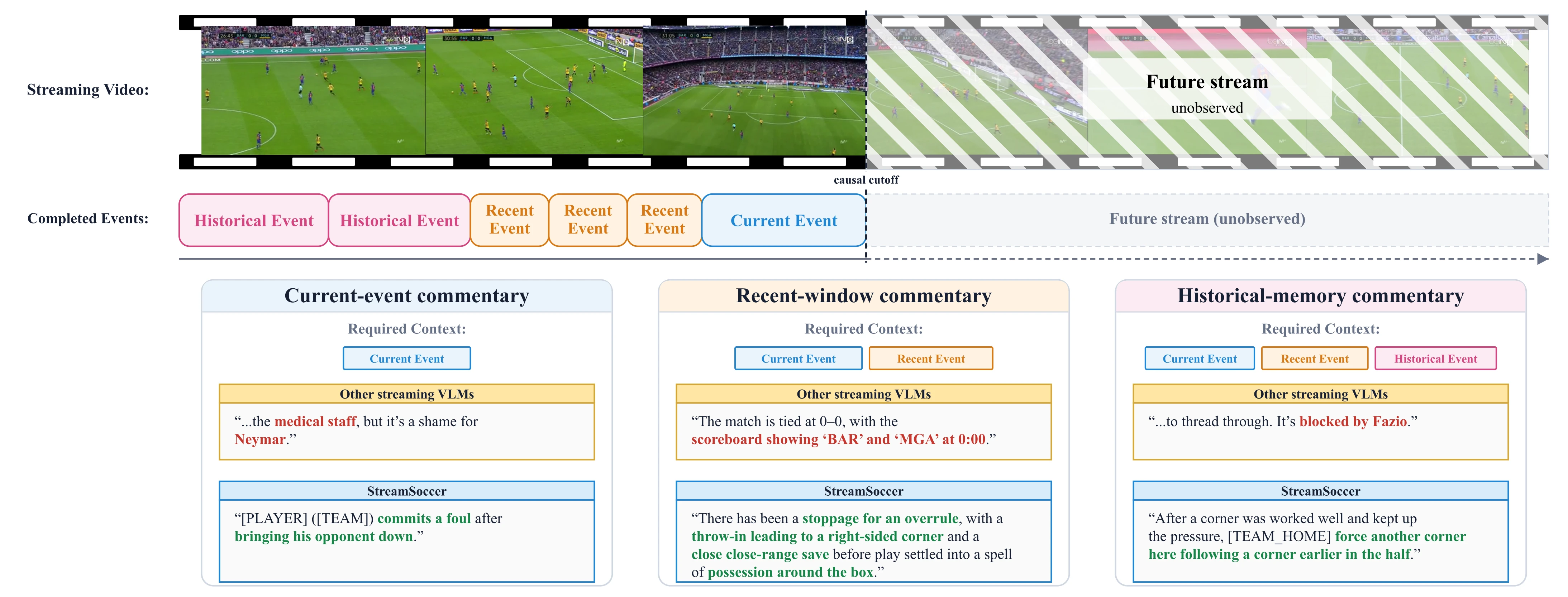
We present StreamSoccer, an event-driven system for causal streaming soccer commentary. It maintains fixed-budget event memory, preserves completed events as local context, and consolidates them into retrievable historical records for current-event, recent-window, and historical-memory commentary.
2024
Mind the Context: Attention-Guided Weak-to-Strong Consistency for Enhanced Semi-Supervised Medical Image Segmentation
Yuxuan Cheng, Chenxi Shao, Jie Ma, Yunfei Xie, Guoliang Li
arXiv preprint Oct. 2024
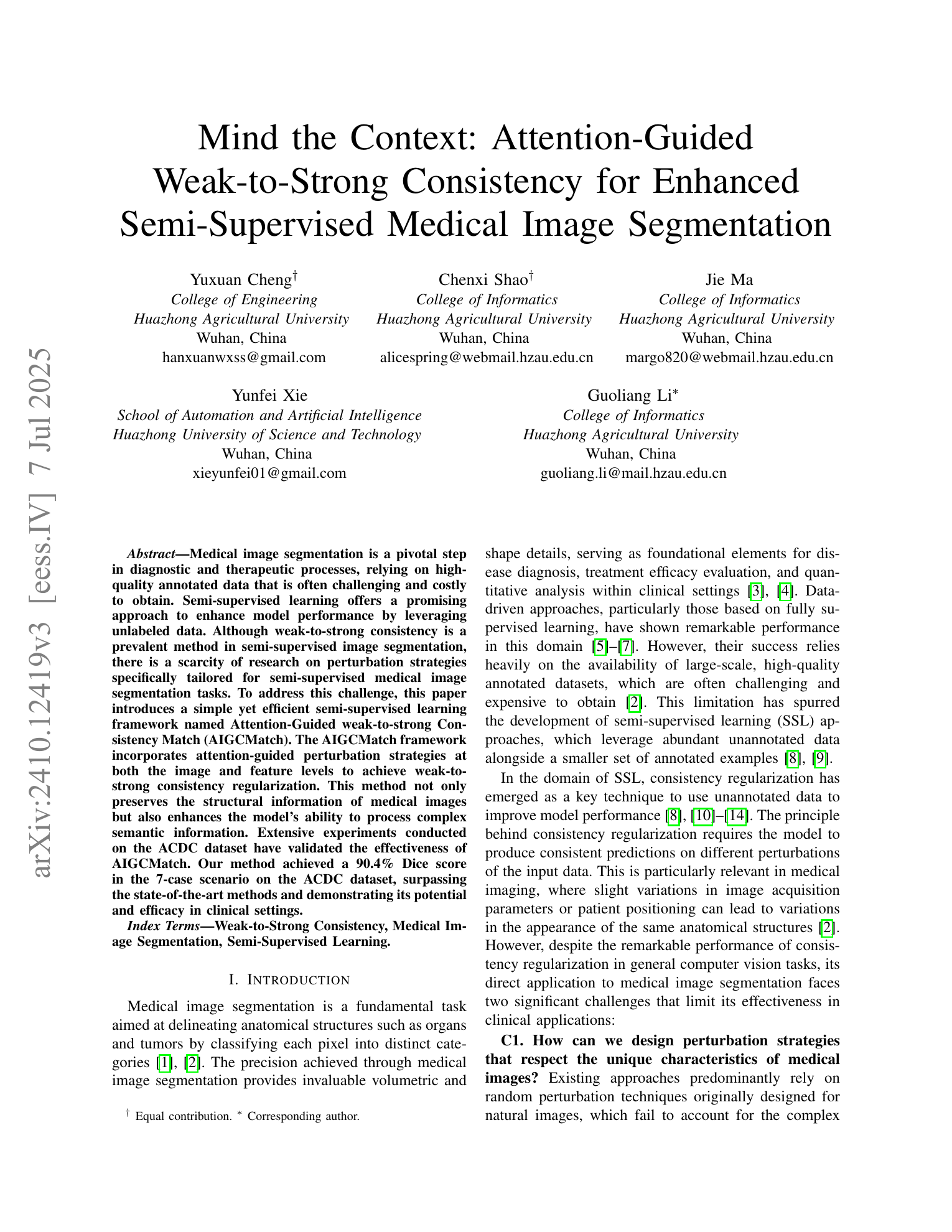
Medical image segmentation relies on high-quality annotated data that is often difficult and costly to obtain. To address this, we propose an Attention-Guided weak-to-Strong Consistency Match (AIGCMatch) framework that incorporates attention-guided perturbation strategies at both the image level and feature level to achieve weak-to-strong consistency regularization. This approach preserves the structural information of medical images while enhancing the model's ability to process complex semantic information. Extensive experiments on the ACDC and ISIC-2017 datasets validate the effectiveness of our method, achieving a 90.4% Dice score on ACDC in the 7-case scenario and significantly outperforming baselines on ISIC-2017.